Explore

Top Attractions & Landmarks in Virginia

From presidential estates and ancient geological wonders to living history museums and national parks — Virginia's top attractions are among the finest in the United States.

Virginia's Extraordinary Landscape of Landmarks

Virginia wears its extraordinary history and natural beauty in equal measure. The state is, in many respects, the very cradle of American civilization — the place where European colonists first established a permanent presence, where a nation of thirteen quarrelsome colonies began to argue its way toward independence, and where some of the most decisive battles of the Civil War were fought over the nature of that hard-won freedom. Layered over this dense historical fabric is a physical landscape of breathtaking diversity: ancient mountains worn smooth by a billion years of erosion, vast cavern systems carved by underground rivers, pristine Atlantic beaches, tidal marshes teeming with life, and the broad, shining estuary of the Chesapeake Bay.

What makes Virginia's attractions truly exceptional is that so many of them remain genuinely world-class destinations rather than simply regional curiosities. Monticello is UNESCO-listed. Shenandoah National Park draws millions of visitors annually and is considered one of the finest examples of temperate hardwood forest in the world. Colonial Williamsburg is the largest living-history museum on Earth. This guide will take you through the very best of Virginia's attractions and help you plan the visit of a lifetime.

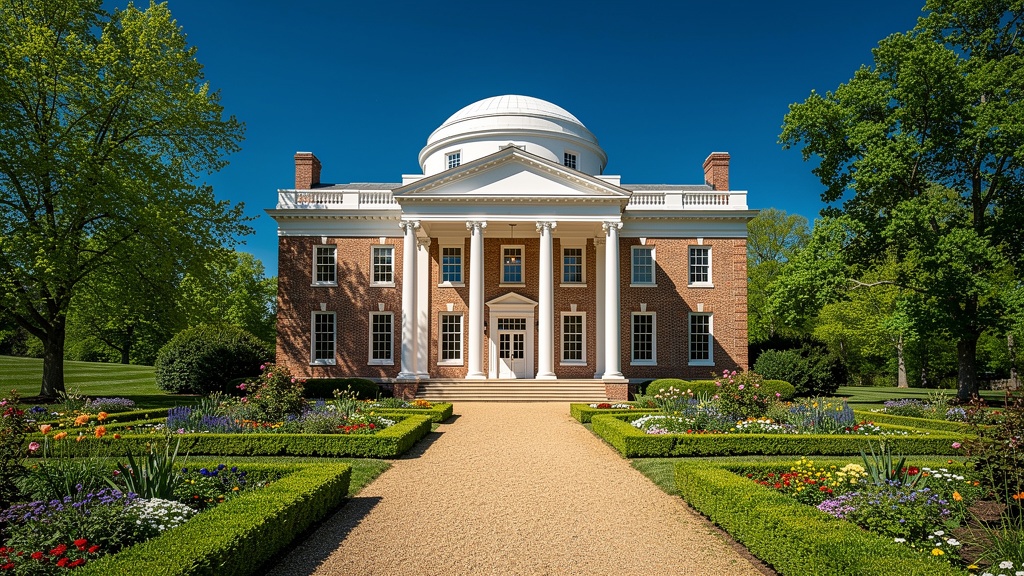
Monticello's neoclassical dome and portico surrounded by formal gardens, Charlottesville Virginia
UNESCO World Heritage Site

Monticello — Thomas Jefferson's Architectural Masterpiece

Perched atop a 867-foot mountain in the foothills of the Blue Ridge Mountains near Charlottesville, Monticello is one of the most remarkable homes ever built in the United States. Thomas Jefferson — author of the Declaration of Independence, third President of the United States, founder of the University of Virginia, and one of the most polymathic intellects in American history — spent 40 years designing, building, and perpetually modifying his home, which he described as his "essay in architecture." The result is a neoclassical masterwork that draws on the architectural theories of Andrea Palladio and the designer's own inventive genius in equal measure.

The house's iconic dome — the first dome ever built on an American private residence — has graced the back of the American nickel for nearly a century. Inside, the rooms are filled with Jefferson's extraordinary collection of Native American artefacts, scientific instruments, books, and works of art gathered during his years as Ambassador to France and through correspondence with scientists and explorers around the world. Skylights, alcove beds, an indoor weather vane, and a complex system of dumbwaiters reveal the restless inventiveness of the man who lived here.

The grounds of Monticello are equally compelling. Jefferson's precisely laid-out vegetable garden on the south side of the mountain was a lifelong experiment in horticultural science, containing over 350 varieties of vegetables and herbs. The orchard preserved rare cultivars of Virginia apples and pears. The restored Mulberry Row, the quarter-mile-long plantation road where enslaved craftspeople and labourers lived and worked, tells the full, complicated story of the estate with admirable honesty and scholarly rigour. The Mountaintop Experience tours now offer comprehensive insight into the lives of the more than 400 enslaved people who built and maintained Monticello, a history that Jefferson's Foundation has committed to interpreting with the depth and seriousness it deserves.

  • UNESCO World Heritage Site since 1987
  • Open daily; peak season tours sell out quickly — book in advance
  • Located 3 miles southeast of Charlottesville off VA-53
  • Combination tickets available with Ash Lawn-Highland (James Monroe's estate)
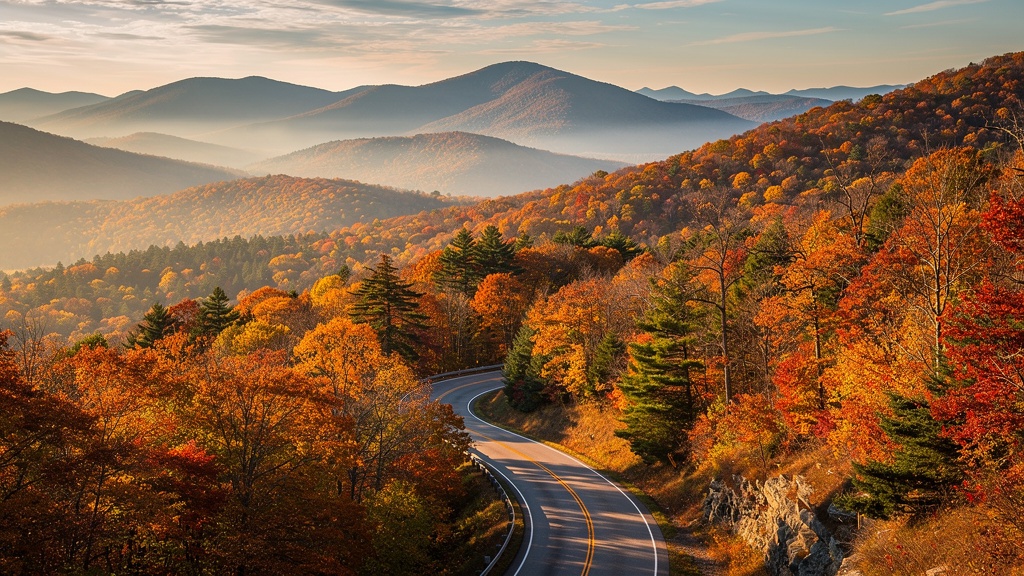
Skyline Drive winding through the vibrant autumn forest canopy of Shenandoah National Park
National Park

Shenandoah National Park — The Crown of the Blue Ridge

Stretching for 105 miles along the crest of the Blue Ridge Mountains in the northwestern corner of Virginia, Shenandoah National Park is one of the most visited and most beloved national parks in the entire United States. Established in 1935 after decades of advocacy by conservationists who recognized the extraordinary ecological significance of the region, the park protects some 80,000 acres of temperate hardwood forest, 500 miles of hiking trails, more than 30 cascading waterfalls, abundant wildlife, and the spectacular Skyline Drive — a 105-mile scenic roadway that runs the entire length of the park along the mountain crest, offering breathtaking views eastward over the Piedmont and westward into the legendary Shenandoah Valley.

The park is a four-season destination, but autumn is when it truly reaches its apotheosis. Between early October and mid-November, the vast hardwood forest — dominated by oaks, hickories, maples, and tulip poplars — transforms into a conflagration of gold, crimson, orange, and amber. The Skyline Drive becomes one of the most celebrated scenic drives in America, with overlook pullouts offering panoramic views of the colour-saturated landscape below. Plan to arrive early on weekends during peak foliage season, as the drive becomes very busy and some sections can experience significant traffic delays.

The park's wildlife is another extraordinary draw. Black bears are frequently spotted along Skyline Drive and on backcountry trails, and the park supports healthy populations of white-tailed deer, wild turkey, peregrine falcon (successfully reintroduced after near-extinction in the mid-20th century), and the elusive bobcat. The streams and rivers within the park, particularly the Rapidan River, are treasured by fly fishers for their populations of native brook trout. Big Meadows, a high-elevation open plateau near the centre of the park, is one of the finest wildlife-watching locations on the East Coast.

  • 105 miles of Skyline Drive — one of America's great scenic roadways
  • 500+ miles of hiking trails, including sections of the Appalachian Trail
  • Luray Caverns just 8 miles west of the park's western boundary
  • Annual passes available via the America the Beautiful program
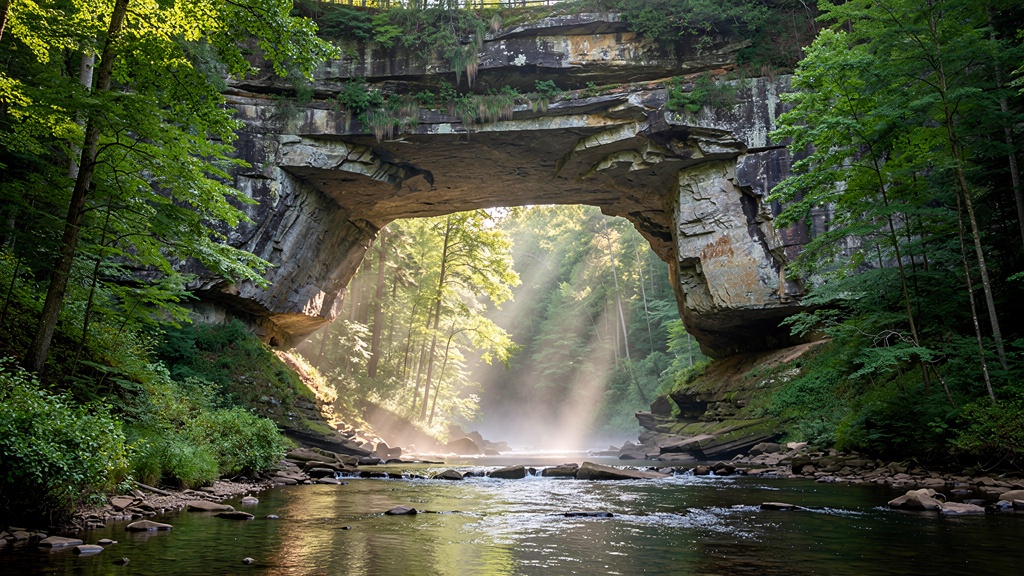
Natural Bridge Virginia — massive limestone arch 215 feet high spanning Cedar Creek in lush forest
Natural Wonder

Natural Bridge State Park — Virginia's Ancient Stone Cathedral

Among Virginia's most astounding natural wonders, Natural Bridge is a geological marvel that has awed human observers for thousands of years. This massive limestone arch, 215 feet high and 90 feet wide, was carved by Cedar Creek over the course of millions of years and represents one of the most dramatic examples of karst topography in the eastern United States. The Cherokee regarded it as a sacred site they called the "Bridge of God." George Washington surveyed it in his youth and carved his initials into the stone — initials that remain visible to this day. Thomas Jefferson was so captivated that he purchased Natural Bridge and the surrounding 157 acres from King George III in 1774 and built a guest cabin there to accommodate the steady stream of admirers who came to see it.

Today, Natural Bridge State Park offers visitors an array of trails and natural experiences beyond the bridge itself. The Cedar Creek Trail winds through the gorge beneath the bridge, continuing to Lace Falls — a delicate cascade that tumbles 30 feet into a mossy pool — and to the Monacan Indian Living History Village, where interpreters share the culture and history of the Monacan Nation, one of the most significant indigenous peoples of the Virginia Piedmont and Blue Ridge region. The Monacan people have lived in the region for at least 10,000 years, and their presence at Natural Bridge predates European contact by millennia.

The Virginia Caverns at Natural Bridge, a separate attraction adjacent to the state park, plunge visitors 34 stories underground through a series of spectacular cavern rooms adorned with extraordinary formations of stalactites, stalagmites, flowstone, and cave bacon. Guided tours take approximately 45 minutes and offer a fascinating geological journey that beautifully complements the surface experience at the bridge.

Visitor Information — Natural Bridge State Park

Address: 6477 S Lee Hwy, Natural Bridge, VA 24578  |  Hours: Daily, dawn to dusk  |  Admission: State park entrance fee applies  |  Tip: Visit on a weekday morning to enjoy the bridge in near-solitude before tour groups arrive.

More Iconic Virginia Destinations

⚑ Arlington National Cemetery

Across the Potomac River from Washington D.C., Arlington National Cemetery is the most hallowed burial ground in the United States. More than 400,000 military veterans, heroes, and national figures are interred here across 639 acres of beautifully maintained grounds. The Tomb of the Unknown Soldier, guarded 24 hours a day, 365 days a year by a sentinel from the 3rd U.S. Infantry Regiment, is one of the most moving sights in America. The graves of President John F. Kennedy and Robert Kennedy, marked by an eternal flame, draw millions of visitors annually. The hourly changing of the guard ceremony at the Tomb is performed with breathtaking precision and solemnity.

The cemetery offers guided tours by electric tram, allowing visitors to see the major monuments and gravesites comfortably. Walking tours are equally rewarding, particularly in spring when cherry trees are in blossom and the grounds take on an ethereal quality. The Memorial Amphitheater, an elegant marble structure built in 1920, hosts the national Memorial Day and Veterans Day ceremonies. Arlington House, the antebellum mansion that served as the home of Robert E. Lee before the Civil War and now operates as a National Memorial, crowns the highest point of the cemetery and offers sweeping views of the Washington D.C. skyline.

🌀 Luray Caverns

Discovered in 1878, Luray Caverns is the largest cavern system in the eastern United States and one of the most visited natural attractions in Virginia. The caverns spread beneath the Shenandoah Valley floor in a series of vast, cathedral-like rooms adorned with spectacular formations that have been growing for hundreds of millions of years. Stalactites and stalagmites of extraordinary size and variety hang from the ceilings and rise from the floors; mirror-still underground pools reflect the formations with perfect fidelity, creating an otherworldly doubling of the geological spectacle above.

The centrepiece of the caverns is the Great Stalacpipe Organ, the world's largest natural musical instrument, which uses rubber mallets to tap 37 stalactites across 3.5 acres of the cave to produce remarkably pure musical tones. Built by mathematician and scientist Leland Sprinkle over a period of three years, the organ is tuned to concert pitch and can play any piece of music. Guided tours take approximately one hour and maintain a comfortable year-round temperature of 54°F (12°C) inside the caverns — cool in summer and warm in winter. The Luray Singing Tower, a 117-foot Belgian Carillon with 47 bells, performs concerts on the grounds above.

🏛️ Colonial Williamsburg

Colonial Williamsburg is the world's largest and most comprehensive living history museum, and no description truly prepares visitors for the immersive experience of walking its 301-acre historic area. The city of Williamsburg served as the colonial capital of Virginia from 1699 to 1780, and the restoration project initiated by John D. Rockefeller Jr. in the 1920s has produced a remarkable reconstruction of 18th-century urban life that encompasses 88 original colonial-era buildings, more than 500 reconstructed structures, and an army of costumed interpreters who bring the political, social, and economic life of the pre-Revolutionary era vividly to life.

The Governor's Palace, the Capitol Building, the Raleigh Tavern, the Magazine and Guardhouse, and dozens of trades shops — where blacksmiths, wigmakers, silversmiths, coopers, and shoemakers ply their historic crafts — are all open for exploration. The Art Museums of Colonial Williamsburg houses one of the finest collections of American decorative arts and folk art in the country. Evening programmes, candlelight tours, and special programmes exploring the lives of enslaved people in colonial Virginia add depth and nuance to the visitor experience throughout the year.

🌊 Virginia Beach Waterfront

Virginia Beach is Virginia's most visited tourist destination and the most populous city in the Commonwealth. Its appeal is immediately obvious: 35 miles of pristine Atlantic Ocean beach, a vibrant three-mile oceanfront boardwalk lined with restaurants, shops, and entertainment venues, and a resort district that offers every conceivable beach vacation experience from parasailing and jet-skiing to world-class surfing and sport fishing. The Neptune Festival each autumn draws hundreds of thousands of visitors with its sand castle competition — one of the largest in the world — live music, and arts and crafts exhibitions.

Beyond the resort area, Virginia Beach reveals a city of surprising depth and diversity. The Virginia Aquarium & Marine Science Center houses over 800,000 gallons of aquarium exhibits and is one of the finest marine science institutions in the mid-Atlantic. The First Landing State Park at the northern end of the city marks the spot where the Jamestown settlers first came ashore in 1607, and its trails wind through a remarkable maritime forest of bald cypress and live oak. The Naval Air Station Oceana, the East Coast's master jet base, makes the skies above Virginia Beach one of the great free air shows in America.

🗺️ The Historic Triangle

The Historic Triangle — encompassing Colonial Williamsburg, Jamestown, and Yorktown — represents the most concentrated collection of nationally significant history in the United States, and possibly in the entire Western Hemisphere. The three communities, linked by the 23-mile Colonial Parkway, collectively tell the complete story of American civilization from its English colonial beginnings at Jamestown in 1607 to its revolutionary culmination at Yorktown in 1781, where the last major battle of the American Revolution ended with the surrender of British General Cornwallis to George Washington and French General Rochambeau.

Jamestown Settlement, operated by Jamestown-Yorktown Foundation, recreates the world of the early colonists with remarkable fidelity: full-scale replicas of the three ships that brought the first settlers to Virginia, a reconstructed Powhatan Indian village, and a meticulously reproduced colonial fort inhabited by costumed interpreters. Historic Jamestowne, the archaeological site of the original 1607 settlement, reveals the ongoing excavation of the fort's foundations and offers visitors a direct encounter with the physical evidence of America's earliest English colonial presence. The Yorktown Battlefield, administered by the National Park Service, preserves the earthworks, redoubts, and positions of the decisive 1781 siege in remarkable condition.

🌊 Chesapeake Bay Bridge-Tunnel

One of the most extraordinary pieces of civil engineering in the world, the Chesapeake Bay Bridge-Tunnel stretches 17.6 miles across the mouth of the Chesapeake Bay, connecting Virginia Beach and the Hampton Roads area to Virginia's Eastern Shore. The structure combines bridges, tunnels, and artificial islands in a complex that took three and a half years to build and was named one of the Seven Engineering Wonders of the Modern World by the American Society of Civil Engineers upon its completion in 1964. Fishing piers attached to the two man-made islands are among the most productive saltwater fishing spots on the East Coast, and the drive itself — rising and falling above and below the bay's surface — is a uniquely thrilling travel experience unlike any other road trip in the United States.

Practical Visitor Tips for Virginia's Top Attractions

Virginia's premier attractions require a little advance planning to get the most from your visit. Here are essential tips from experienced Virginia travelers:

📅 Book Monticello in Advance

Monticello timed-entry tickets sell out weeks or even months in advance during spring and summer. Book your tickets online at monticello.org as soon as your travel dates are confirmed. The first tour of the morning (9:00 AM) is often the most peaceful, before bus tours arrive from Washington D.C. and Richmond.

🚗 Get a Colonial Williamsburg Annual Pass

If you're spending more than two full days in Colonial Williamsburg — which is very easy to do — the Annual Pass quickly pays for itself. The pass grants unlimited access to all historic area buildings, museums, and evening programmes. Multi-day packages including accommodation at Colonial Williamsburg's own hotels offer exceptional value.

🍂 Plan Shenandoah Foliage Timing Carefully

Peak foliage in Shenandoah National Park typically occurs in the second and third weeks of October, though the exact timing shifts by one to two weeks depending on the summer's temperatures. The park updates foliage reports on its website. Arrive at Skyline Drive's Dickey Ridge Visitor Center by 8:00 AM on October weekends to secure parking and avoid the worst congestion.

🎟️ America the Beautiful Pass

If you plan to visit multiple national parks and federal recreation areas — and Virginia has many — the America the Beautiful annual pass at $80 per vehicle pays for itself very quickly. The pass covers entrance fees at Shenandoah National Park, Appomattox Court House, Colonial NHP, George Washington Memorial Parkway, and dozens of other sites across the state.